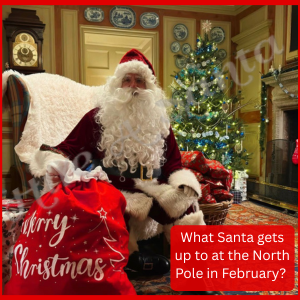
What Happens at the North Pole in February? When the decorations are packed away and…
Behind the Beard: A Day in the Life of a Professional Santa
Ever wondered what a professional Santa actually does from the moment he starts getting ready to when the final child waves goodbye? There is rather more to it than putting on a red suit and perfecting a good Ho Ho Ho. A Santa day can involve early starts, costume checks, storytelling, photographs, reindeer questions, singalongs, hundreds of names and more than a few unexpected moments. So, for once, we are stepping away from the grotto chair and following Santa through a full festive working day.
The Santa Day Starts Long Before the First Ho Ho Ho
A professional Santa’s day often begins surprisingly early, especially if the first booking is a breakfast with Santa, a school visit or an event where families arrive from the moment the doors open.
There is no simply throwing on the suit five minutes beforehand and hoping for the best. Santa needs time to get himself ready properly because once he is dressed and visible, he is effectively on duty.
The suit comes first. It needs to look clean, smart and exactly as children expect. Then there are the boots, belt, gloves and hat, followed by the beard, which can be a job in itself. A real beard Santa may have spent much of the year carefully growing and maintaining it, while every Santa has their own routine for making sure the overall appearance feels right.
There are also the bits nobody sees. Checking the day’s timings, confirming where he needs to be, finding the changing area and discovering whether the nearest cup of tea is within Santa’s walking distance.
By the time the first family arrives, all of that needs to disappear. Santa should look as though he has simply stepped out of the North Pole rather than spent the last half hour trying to find the staff entrance.
The Transformation from Performer to Santa
There is an interesting point during the preparation where the performer begins to disappear, and Santa takes over.
The posture changes, the voice settles into place, and the pace becomes noticeably more Santa-like. After all, Father Christmas does not generally sprint through corridors or mutter because he has misplaced his glasses.
Experienced Santas tend to move more deliberately once they are in costume because they know a child could appear at any moment. At a hotel or garden centre, Santa may need to walk through public areas before reaching the main event space, and there is always the possibility that somebody will spot him.
Once that happens, there is no switching the character off.
A child seeing Santa unexpectedly in a corridor can be every bit as excited as one entering a beautifully decorated grotto, so the smile goes on, the wave appears, and the first Ho Ho Ho of the day may happen before Santa has even reached his chair.
The First Children Arrive
The first visits of the day are usually a good reminder that no two children are ever the same.
One child may walk straight in and launch immediately into a highly detailed Christmas list without so much as a hello. Another might hide behind Mum and look suspiciously at Santa from a safe distance. A third may have prepared several questions and clearly intends to use every second of their appointment.
Santa has to work that out very quickly.
There is no standard conversation because children do not follow scripts. A chat might start with Christmas presents and somehow end with dinosaurs, football, the family dog or why a younger brother has behaved very badly this week.
That unpredictability is half the fun.
One of the nicest parts of watching experienced Santas work is seeing how naturally they follow the child’s lead. If a child wants to talk, Santa listens. If they are nervous, he slows things down. If they want to inspect his beard from approximately three inches away, he accepts that his personal space has temporarily disappeared.
Then Come the Santa Questions
No professional Santa gets through a December without being questioned.
Children want facts, and they want them immediately.
- How do you get into houses without chimneys?
- Where is the sleigh parked?
- Why did you not bring Rudolph?
- How do you carry all the presents?
- Do the elves sleep?
- How old are you?
And sooner or later, somebody will ask why Santa looked different when they saw him somewhere else.
A good Santa develops quite an impressive bank of answers over the years. Magic keys solve the chimney problem. Christmas magic deals with most questions involving time and distance. Rudolph is usually resting, training or otherwise occupied with an important North Pole task.
Some questions are harder than others, but that is part of the performance. Santa needs to answer with enough confidence that the child accepts it and happily moves on.
The moment Santa starts looking as though he might need to Google the answer, things could become complicated.
A Professional Santa Does a Lot of Listening
For somebody famous for a booming Ho Ho Ho, Santa spends a surprising amount of his day listening. Children have things they want him to know, and not all of them involve presents.
They talk about school, pets, their friends, new siblings, swimming certificates and the fact they have finally learnt to ride their bike. Some give Santa a full update on family politics, usually without any concern about whether the adults in the room wanted that information shared.
There are also the children who have been waiting all year to explain why a brother or sister deserves careful review by the Nice List department.
For Santa, these conversations make each visit different.
A detail mentioned early in the conversation can be picked up again a few minutes later, which often delights children because it feels as though Santa really has been listening. That may be something as simple as remembering the dog’s name or asking whether football training is still going well.
It is often those small bits of conversation that make the day enjoyable for the performer too.
Mid-Morning and the Grotto Is in Full Swing
By mid-morning, the rhythm of the day has usually settled. At a busy Santa event, families may be arriving continuously, photographs are being taken, elves are helping visitors move through the experience, and somebody somewhere is probably singing Jingle Bells.
Santa becomes very good at moving between completely different conversations without losing the thread.
One minute he is talking to a three-year-old who refuses to speak but is willing to communicate entirely through nodding. The next he is answering surprisingly technical questions from an eight-year-old about sleigh propulsion.
Then comes a family photograph involving four children, two parents, a grandparent and occasionally a dog, Santa smiles through all of it.
A busy grotto can be tremendous fun because every few minutes brings a completely different family and another little story.
Santa’s Lunch Break Is Not Always Very Santa-Like
Eventually Santa needs a break.
This is one of those moments children rarely think about because, naturally, Santa should probably be eating mince pies in a snowy workshop rather than drinking water in a staff room.
In reality, Santa suits are warm. Very warm. After several hours of conversation, photographs and enthusiastic festive greetings, a quiet break is important. There is usually water, perhaps some food and a few minutes where the performer can sit somewhere considerably cooler.
Depending on the venue, there may even be a carefully planned explanation for Santa’s disappearance. Perhaps he is checking on the reindeer, speaking to the elves or dealing with something urgent at the North Pole.
Meanwhile, behind the scenes, Santa is probably having a sandwich, even Father Christmas needs lunch.
The Afternoon Brings a Second Wave of Christmas Energy
After the break, it starts all over again.
For a hotel event, this might mean afternoon-tea families arriving. At a garden centre, the grotto may be entering one of its busiest periods, and Santa might be moving from one class to another at a school. The afternoon often brings slightly different energy because children have had more time to become excited. Santa may find himself leading songs, reading stories or being asked to judge whether somebody’s Christmas jumper is festive enough.
This is also when stamina starts to matter. The child visiting at 3.45pm has been looking forward to meeting Santa just as much as the child who arrived at 9.30am, so the warmth and enthusiasm need to remain exactly the same.
An experienced performer becomes very good at resetting between visits. One family leaves, there is a moment to breathe, and then the next child walks through the door, and the experience begins again.
Some Santa Days Take Unexpected Turns
Not every professional Santa spends the entire season sitting in a grotto, that is where the job becomes particularly interesting. Over the years, Santas can find themselves appearing at school assemblies, wandering through hotels, visiting family homes, arriving at restaurants and taking part in community events. Then there are the slightly more unusual bookings.
We have had Santas appear at zoos, travel in army tanks and even end up in handcuffs with the police as part of festive events. There cannot be many professions where you can begin the day reading a Christmas story to children and end it climbing into a military vehicle dressed as Father Christmas.
The key is simply staying Santa throughout, whatever happens, the character continues.
The Final Families of the Day
Eventually, the queue gets shorter and the last few families begin arriving. By now Santa may have spoken to dozens, sometimes hundreds, of children.
He has heard an extraordinary range of Christmas requests, answered more questions about Rudolph than seems humanly possible, and probably posed for enough photographs to fill several family albums.
Yet the final child does not know any of that. For them, this is their Santa moment. That is why professional performers make a conscious effort to keep the interaction fresh right to the end. The last family deserves the same attention and humour as the first. Sometimes those final visits produce the loveliest moments because the day has become quieter and everyone has a little more breathing space.
Taking Off the Beard
Eventually, the last family leaves, the Christmas music stops, and Santa can finally step out of character.
There is something slightly strange about seeing the transformation happen in reverse. The hat comes off, the belt is loosened, the boots are removed, and the performer slowly reappears.
The suit still needs looking after because another booking may be coming very soon. During the busiest weeks of December, Santa could be back in costume the following morning, ready to do the whole thing again.
There may also be messages from the day to look through, photographs to smile at or feedback from a venue saying how much the children enjoyed themselves.
Then it is time to head home, usually looking considerably less recognisable than the person who has spent the entire day being photographed.
So What Is It Really Like to Spend a Day as Santa?
It is probably more tiring than people imagine, definitely warmer than people imagine and considerably funnier than people imagine.
A professional Santa spends his day moving between performance and genuine conversation. He has to stay alert, listen carefully and be ready for whatever question walks through the door next.
Some moments are hilarious, some are unexpectedly touching, and others are wonderfully ordinary.
That is perhaps the nicest thing about the role. Behind all the Christmas magic, Santa’s day is really a collection of hundreds of little conversations. A child telling him about their dog, families laughing together for a photograph. A shy youngster finally whispering what they would like for Christmas and a parent quietly mouthing “thank you” as they leave.
At the end of the day, the beard comes off, and the red suit gets packed away, but those little moments are what the performer takes home.
And then, usually after a good night’s sleep, Santa gets up and does it all again.
Because December is busy at the North Pole.

Related Posts